Artemis II Delayed to March
NASA’s Artemis II mission will launch no earlier than March due to several issues that were encountered during a launch rehearsal last night.
Read More

NASA’s Artemis II mission will launch no earlier than March due to several issues that were encountered during a launch rehearsal last night.
Read More
The Artemis program, while relatively young, incorporates elements that have had long and winding development histories, which is reflected in the evolution of its earliest mission plans over time.
Read More
Early Saturday morning, NASA rolled out the Space Launch System rocket and Orion spacecraft that will send humans back to the Moon for the first time in 54 years.
Read More
On December 2nd, 2025, a team led by researchers at Tohoku University in Japan announced the identification of Ribose, Glucose, and other sugars in a sample of the asteroid Bennu returned by NASA’s OSIRIS-REx mission in 2023.
Read More
Blue Origin saw a resounding success on the second flight of their mammoth New Glenn launch vehicle Thursday, successfully placing NASA’s twin ESCAPADE spacecraft on a trajectory toward deep space.
Read More
NASA’s IMAP mission is set to launch on September 24, 2025, aboard a SpaceX Falcon 9 rocket. This launch brings 3 separate missions to the Earth-Sun L1 Lagrange point: IMAP, the Carruthers Geocorona Observatory, and NOAA’s SWFO-L1.
Read More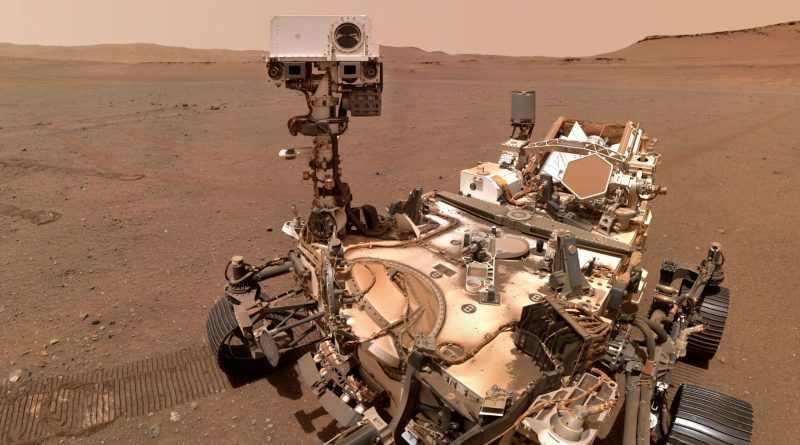
Ambitious plans by NASA and the European Space Agency to return samples of the Martian surface to Earth continue to remain in limbo even as the Agency has announced the collection of a potentially biosignature-containing sample aboard the Perseverance rover.
Read More
At the December 2024 annual meeting of the American Geophysical Union (AGU24), NASA provided updates on the status of NASA’s upcoming Uranus Flagship mission and the precursor projects that will enable it.
Read More
Asteroid exploration is not for the faint of heart, and the latest mission announced in a long line of asteroid explorers does not shy away from a challenge. The UAE has become the latest nation to set their sights on asteroids close to home, with an ambitious mission lined up to explore not one, but 7 Near Earth Asteroids.
Read More
NASA’s Europa Clipper mission, a 5 billion dollar Jovian orbiter, will aim to answer questions about one of the most tantalizing candidates for life in the solar system: the gas giant’s icy moon of Europa.
Read More
The European Space Agency’s Hera spacecraft has lifted off on a unique mission to the binary asteroid pair Didymos and Dimorphos. The probe will seek new insights into planetary defense techniques that could protect the Earth from asteroid impacts in the future, following up on NASA’s DART mission which intentionally struck Dimorphos in September of 2022.
Read More
On Friday, September 6th 2024, NASA announced an official delay of the EscaPADE mission’s launch to March of 2025. The agency specified that the decision came at potential risk to spacecraft health in the event that the twin Mars orbiters had to be unfueled following a launch delay. Regardless, work continues towards the first launch of Blue Origin’s New Glenn.
Read More
Artemis’ stated goal to “prepare for human missions to Mars” is an ambitious undertaking, with visible consequences on its organization. With Artemis entering flight across its various programs, and hardware which will eventually support its primary missions in flow, we have entered a unique era for spaceflight.
Read More
At its core, the Artemis Program represents a new way of thinking in space exploration. NASA’s Moon to Mars objectives incorporate the Artemis Program as part of the roadmap to the Red Planet.
Read More
For Asteroid Day 2024, we’ll be briefly covering updates to various small body missions, and exploring how these vital ambassadors from Earth teach us so much about our origins.
Read More
NASA and SpaceX have launched GOES-U, the final Earth observation satellite in the GOES-R series. The spacecraft was launched aboard a SpaceX Falcon Heavy, dodging inclement weather to lift off from Launch Complex 39A at 5:26 PM EDT on July 25th, 2024.
Read More
NASA and NOAA are preparing to launch GOES-U, the last of the four GOES-R series geostationary weather satellites on June 25th, 2024 at 5:16PM, Eastern Time atop a SpaceX Falcon Heavy.
Read More
NASA’s Hubble Space Telescope has suspended science operations for the time being. NASA reported that the space observatory entered safe mode on May 24th.
Read More
NASA has enlisted the help of commercial partners to respond to two fronts in exploration, aiming to remove some of the technical and financial burden on the agency, so that larger and more ambitious goals can be accomplished in the next 15 to 20 years.
Read More
The Chinese Lunar Exploration Program, also known as Chang’e, has seen the launch of eight missions and three successful Moon landings since 2007. Chang’e-6 launched on May 3rd at 5:27 p.m. local time, and is China’s most ambitious lunar mission yet.
Read More
On April 15th 2024, NASA hosted a media teleconference giving updates on the current status of the agency’s Mars Sample Return (MSR) mission. MSR is a vital step in providing high fidelity environmental data which could dramatically inform the technology and methodology for a planned human mission to the Red Planet.
Read More
After meeting to discuss ideas and assess technologies, the European Space Agency has begun the process of designing their next “Large Class” mission – one that could explore Saturn’s moons of Enceladus and Titan up close.
Read More
Apophis is an asteroid that needs little introduction, but it could soon become one of the most well studied small bodies in the history of spaceflight – should plans come to fruition.
Read More
The NASA Dragonfly mission, a groundbreaking endeavor aiming to explore Saturn’s moon Titan, is making significant progress towards launch in 2028.
Read More
After a troubled journey to the lunar surface and subsequent recovery, the sun has set on JAXA’s Smart Lander for Investigating Moon (SLIM) at 1:57 PM, February 1st, Japan Standard Time.
Read More
NASA’s Jet Propulsion Laboratory announced Feb. 6 it will lay off 530 employees, about 8% of its staff, citing uncertainty about its budget for 2024.
Read More
After nearly nine years of planning, preparation, and even once being slated for cancellation entirely, NASA’s Plankton, Aerosol, Cloud, ocean Ecosystem (PACE) Earth-observation mission lifted off from Launch Complex 40 at Cape Canaveral Space Force Station on February 8, at 1:33:36 AM.
Read More
Intuitive Machines is targeting February 14th for the launch of IM-1, the first flight of its NOVA-C robotic moon lander as part of NASA’s Commercial Lunar Payload Services (CLPS) initiative.
Read More
After nearly nine years of planning, preparation, and even once being slated for cancellation entirely, NASA’s Plankton, Aerosol, Cloud, ocean Ecosystem (PACE) Earth-observation mission is set for launch
Read More
On January 25, 2024, NASA’s Ingenuity mission officially concluded. The small, autonomous helicopter performed 72 flights on Mars, the first time an aircraft has flown on another planet.
Read More
Astrobotic’s Peregrine lunar lander re-entered the Earth’s atmosphere on January 18th, 2024, ending its mission after a 10 day, tumultuous journey through cislunar space.
Read More
NASA is planning a flagship-class mission to Uranus, the Uranus Orbiter and Probe (UOP), early in the next decade, and an ongoing study may turn atmospheres into a valuable asset for not just UOP, but many missions yet to come.
Read More
In a media teleconference held on January 9th, NASA leadership announced significant delays to the next two missions in its Artemis program.
Read More
On January 8th, 2024, at 2:18:34 AM, United Launch Alliance’s Vulcan rocket flew for the first time, carrying the Astrobotic Peregrine Lunar Lander towards the Moon.
Read More
NASA and the Mohammed bin Rashid Space Centre (MBRSC) of the United Arab Emirates (UAE) announced Sunday plans for the space centre to provide an airlock for Gateway, humanity’s first space station outside of Low Earth Orbit.
Read More
2024 is shaping up to be a year of triumphant lunar return, with several missions planned to welcome in a new age of international exploration of Earth’s nearest neighbor.
Read More
The Deep Atmosphere Venus Investigation of Noble gasses, Chemistry, and Imaging, or DAVINCI mission, is a groundbreaking new approach to studying Earth’s sister planet, one which truly embodies its namesake’s ideology of revolutionary new ideas.
Read More
In a lecture given on November 17, Shri Nilesh M. Desai, director of India’s Space Application Center, outlined India’s next missions to the Moon – including the ambitious and tantalizing official plan for Chandrayaan-4.
Read More
The problem of transporting humans to Mars is a daunting one, yet the slate never stays blank for long. However, if we are to succeed in this boldest of adventures, we must first step away from the whiteboard and take a moment to reflect on our motivations and goals.
Read More
On November 13 2023, NASA’s Planetary Science Advisory Committee, which advises all of NASA’s planetary science interests, held a meeting to discuss the state of various programs heading into 2024.
Read More
A next generation optical communications system known as ILLUMA-T is ready for flight onboard the CRS-29 mission to the International Space Station.
Read More
At NASA’s Ames Research Center in Silicon Valley, California, work on NASA’s next lunar explorer has begun. The Volatiles Investigating Polar Exploration Rover (VIPER) is now in assembly ahead of its projected launch in 2024 onboard a Falcon Heavy.
Read More
On November 1st 2023, NASA’s Lucy spacecraft flew by its first asteroid, just over ten months after the previously unplanned encounter was declared.
Read More
As NASA prepares to go back to the moon, the CLPS program stands on a dangerous fulcrum – will program structure help or hurt our lunar return?
Read More
Nearly two years after launch, NASA’s Lucy spacecraft prepares to encounter its first asteroid – one of many to come.
Read More
On Friday the 13th, 2023 SpaceX’s Falcon Heavy beat the odds and
lifted off carrying NASA’s Psyche spacecraft on a two billion mile trek to the asteroid of its namesake.

After a technical delay the previous week, NASA’s Psyche mission remains grounded in the face of weather constraints.
Read More
In the atmosphere of an exoplanet 120 light years away from Earth, the James Webb Space Telescope (JWST) has detected carbon-bearing molecules, some of which have scientists questioning the possibility of life elsewhere in the universe.
Read More
The solar system contains 8 planets, each possessing incredible uniqueness. Of these, some stand out as being perhaps the least explored. Every planet has had at least one orbiter take incredible amounts of in situ observations for years on end if not decades, except the Ice Giants…
Read More
After 7 years in space, and 3.8 billion miles traveled, NASA’s OSIRIS-REx Sample Return Capsule (SRC) completed a picture perfect touchdown on the muddy sands of the Utah Test and Training Range in Dugway, Utah
Read More
This past year saw an unexpected addition to the list of record-setting flights – Frank Rubio and the crew of MS-22’s stay on the International Space Station lasting 371 days.
Read More
On the 24th of September, NASA’s OSIRIS-REx spacecraft will complete its primary mission, delivering nearly 1 kilogram of material from the asteroid Bennu after 7 years in space.
Read More
Six years into the future and 177 years after its discovery, the massive asteroid 16 Psyche will receive its first visitor from Earth.
Read More