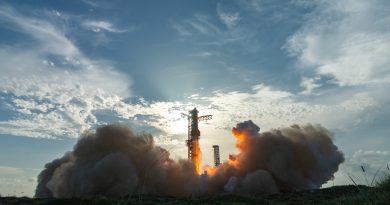
Rollout Brings the Dawn of Artemis II

Early Saturday morning, NASA rolled out the Space Launch System rocket and Orion spacecraft that will send humans back to the Moon for the first time in 54 years. The Artemis II mission is readying to launch as soon as February 6th, and its crew of four astronauts have arrived in Florida for final preparations ahead of their flight. After a full year of debate and uncertainty about the future of the Artemis Program, the sight of SLS and Orion leaving the VAB marks a symbolic triumph for NASA as it prepares to send people farther from Earth than ever before.

The rocket now slowly crawling the four-mile, twelve-hour trek towards Launch Complex 39B is only the second full stack the Artemis Program has seen, after the Artemis I mission in November of 2022. The SLS Block 1 configuration pairs a large hydrogen-fuelled core stage with two solid rocket boosters, topped with a small Interim Cryogenic Propulsion Stage to send the Orion spacecraft around the Moon and back. In the morning sun, the Artemis II rocket showed slightly different markings than the one built for Artemis I: the NASA “worm” logos on the boosters are rotated away from the tower for visibility, and the top of each booster bears the America 250 logo, commemorating the 250th anniversary of the United States’ independence.

NASA Administrator Jared Isaacman and the Artemis II crew members spoke with press as the Artemis rocket, stacked on Mobile Launcher-1, trundled towards the launch pad. Reid Wiseman, the mission’s commander, praised the monumental teamwork of NASA, its centers and workforce across the country, and the international partners that have collaborated to bring the mission together. The Orion spacecraft is powered by a European-built service module, and the rocket proudly bears the logos of both NASA and the European Space Agency. Furthermore, Mission Specialist Jeremy Hansen will become the first Canadian astronaut to visit the Moon; Hansen expressed his gratitude that the United States has embraced international partnerships in the Artemis Program, opening opportunities for other countries and their citizens to rise to the challenge of space exploration. Mission Specialist Christina Koch and Pilot Victor Glover further elaborated on how the promise of new lunar science has changed the way they view the Moon, as their families, friends, and people all across the world look forward to humans venturing into the night sky once again.

The Artemis Program was initiated by the Trump-Pence Administration in 2017 with a goal of landing Americans on the Moon by 2024. Despite a history of delays, the maiden voyage of Artemis I in 2022 finally took Artemis further than any of its predecessors, sending an uncrewed Orion spacecraft into a wide orbit of the Moon and returning it safely to Earth. The program is ultimately striving to fly missions to the Moon once a year, but the thorough review of Artemis I’s performance, including a few standout issues, pushed the first crewed flight into April of 2026. Finally, an aggressive push over the past year managed to pull Artemis II forward by several months, and the mission is now expected to launch no later than April.
The next milestone in the launch campaign will be the Wet Dress Rehearsal, also called a tanking test, where the rocket is filled with cryogenic liquid hydrogen and liquid oxygen propellants to check equipment before launch day. Mr. Isaacman cautioned during the morning’s press event that NASA will refrain from sharing a target launch date until completing this test. Artemis I encountered a number of issues with ground equipment and interfaces that delayed its launch campaign, a natural consequence of testing a new rocket for the first time. Lessons learned in 2022 may help to streamline operations for Artemis II as the SLS rocket comes to life once again.

Due to the Moon’s month-long orbit around the Earth, launch opportunities for Artemis II come in periods of about one week each month, with the first spanning February 6th through the 11th. Space Scout looks forward to providing updates as the launch campaign continues, bringing humanity closer to our long-awaited return to the Moon.